Printed circuit boards are amazing but introduce all sorts of complexities that don't exist in schematics. Here we look at some of the more important issues that PCBs encounter around noise in the power rails.
The CPU clock isn't just an oscillator. It also includes some specific parts that allow it to work with the rest of the computer, and be useful to the intrepid builder.
Getting from an analog oscillating voltage to a nice sharp digital square wave is tricky to get right.
Two's complement is nothing novel, but it usually just gets presented as a list of rules. Here we explore why two's complement works, and how it's used in the Theoputer to enable subtraction.
You can count on me to be pedantic about words like count. The program counter is a critical system, helping us figure out where we are in the program, but calling it a counter is an insult. For shame.
We need a place to store temporary data that's fast and easy to access. Throw on your flip-flops, latch down your data, and register for some fun in the run.
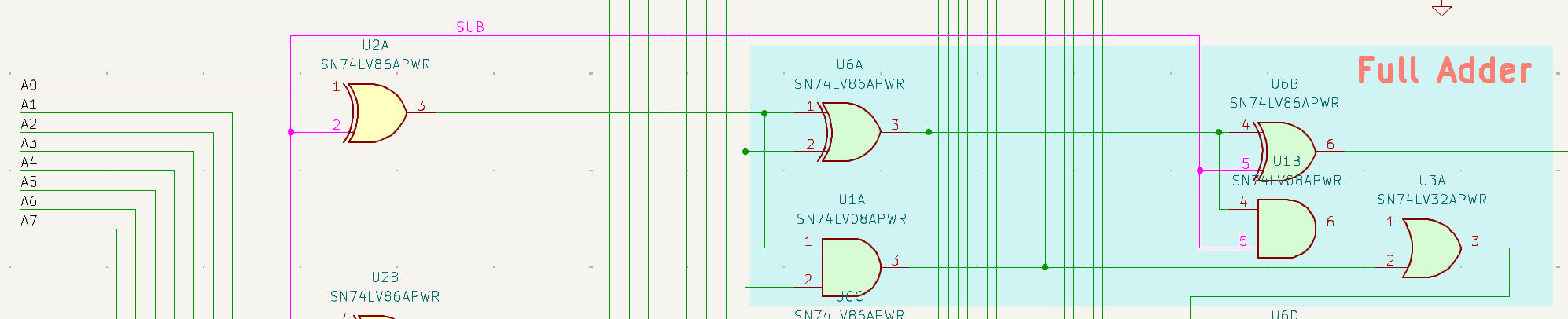
The Arithmetic Logic Unit (ALU) is the Theoputer's core computational component, responsible for various operations including binary addition. But how do we go from logic circuits to arithmetic?
What started as a seemingly small issue with the IRQ circuit turned into a very deep, very subtle expedition into an important property of circuits I never knew about.
Everyone makes mistakes and I make a lot of them. The initial approach to the IRQ board had some problems with the SR latch, but maybe I've finally fixed it...
Simply stop doing what you're doing. Save all your work very quickly. Completely change your task. Plod along and then go back to what you were originally doing. Do all that fast. Interrupt requests are so simple.